August
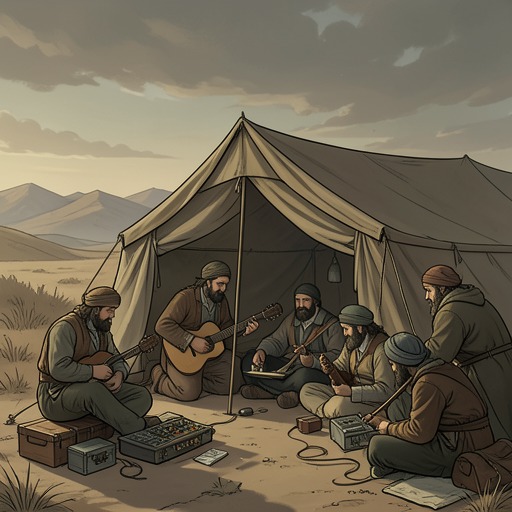
Station ElevenAugust is the Travelling Symphony’s second violin, a latecomer to acting, and a poet whose writing is known only to Kirsten Raymonde and the seventh guitar. His life on the road is shaped by the troupe’s double existence: its members scavenge and keep watch to survive, but rehearse Shakespeare and perform for the people they encounter. August belongs to both worlds, though his absences from rehearsal sometimes make that balance a source of friction. His closest bond is with Kirsten, a friendship built through shared work, private confidences, and repeated acts of care.
Identity and Background
Before finding the Travelling Symphony, August left an empty house in Massachusetts carrying his violin. He fell in with a cult and stayed for three years, then left again and eventually stumbled across the troupe. The account of his past, later given during François Diallo’s interviews in New Petoskey, places two departures at the beginning of his story: first from an emptied home, then from a group that had claimed him. The evidence does not explain what prompted either departure, but it establishes a pattern of leaving and continuing on foot until he found a different kind of community.
In the Symphony, August plays second violin and writes poetry in secret. Only Kirsten and the seventh guitar know about the poems. He has also only recently begun acting, an identity that develops alongside his musical role rather than replacing it. The combination matters to his place in the troupe: he is both an established musician and a beginner at the theatrical work that gives the company its public purpose.
Theatre and Life on the Road
During a slow passage through unfamiliar, hot territory, the Symphony travels cautiously, with weapons in hand and scouts watching the road. The actors use the journey to rehearse. August is learning Edgar in King Lear, and Kirsten prompts him through a line he cannot quite recall. The scene makes rehearsal part of the troupe’s practical routine: the road is not a protected interval before performance, but a place where lines must be learned amid heat, fatigue, and uncertainty.
August’s theatrical commitment coexists uneasily with his approach to survival. The first flute complains that he is forever missing rehearsals to break into houses with Kirsten and, until recently, Charlie Harrison. In her view, he behaves as though the Symphony were a scavenging outfit that happened to play music. The complaint is evidence of real friction within the company, not simply a disagreement about scheduling: the troupe depends on both its practical labor and its performances, and August’s choices can look as if he has put one ahead of the other. His willingness to keep acting and rehearsing nevertheless shows that the theatre remains part of his life on the road.
Away from rehearsal, he joins Kirsten in watch duty at camp. One night, while other scouts cover the road ahead and behind, the two circle the camp perimeter and listen for movement. When they hear a brief, uncertain sound from the direction they came from, August agrees that it was real enough to investigate. Kirsten raises the third watch before they set off together. Their response is measured: they do not know what made the sound, but they treat the possibility of danger as a reason to act.
Friendship with Kirsten and Private Imagination
August and Kirsten’s closeness is explicitly defined as friendship. They made a secret pact to remain friends and nothing else while drinking with locals behind the ruins of a bus depot in a town at the southern end of Lake Huron. The pact gives shape to a bond that might otherwise be read as romantic from the attention they give one another. The novel instead presents their intimacy as durable companionship, with the promise of friendship becoming especially important when the troupe is scattered and people go missing.
His poetry offers a private expression of that loyalty. After Dieter and Sayid disappear and the Symphony is left uncertain about what has happened, Kirsten finds a folded piece of paper in her pocket in August’s handwriting. It is a fragment addressed to a friend, imagining that he would follow and find that person if their soul left the earth. The note does not resolve the danger or explain where August is; its force comes from the fact that it is already with Kirsten, a personal message carried into a moment of fear.
August also gives voice to imaginative possibilities beyond what the survivors can verify. He believes in multiple universes and presents the idea as grounded in physics, or at least at the outer edge of quantum mechanics. The other members Kirsten asks cannot confirm his account. She pictures his infinite series of worlds as reflections in facing mirrors, each image growing cloudier until it disappears. The episode keeps August’s speculation distinct from established knowledge: it is a theory he champions, while the novel shows how the idea becomes something Kirsten can visualize without pretending that anyone in the Symphony has proved it.
In a separate conversation about television, August calls a line from Star Trek one of the best ever written for a television show and asks whether Dieter saw the episode. The exchange gives his cultural memory a place beside Shakespeare and poetry. He is not confined to the troupe’s repertory: he can value a remembered television line even when Dieter does not share his enthusiasm.
Separation, Protection, and the Road Ahead
Three days after Kirsten and August become separated from the Symphony near Severn City, Kirsten wakes from a dream in which she has lost him and believes he is dead. August is beside her, with a hand on her arm, and reassures her that he is there. The scene reverses the fear of the dream without erasing the real separation: for the moment, the two are together, but the troupe remains elsewhere and the journey has brought them to the outskirts of Severn City.
When Sayid reappears with three armed companions, August acts alongside Kirsten to protect him. August assigns himself the gunman and tells Kirsten to deal with the archer. He throws a stone to draw the men’s attention and sends an arrow toward the gunman; Kirsten’s thrown knife stops the archer. The boy runs off, while the immediate threat is broken. August then curses under his breath and notices that the dog they thought they heard is nowhere to be seen. His attention moves quickly from the confrontation to the discrepancy in what they heard, preserving the group’s uncertainty rather than treating the encounter as fully explained. Kirsten goes to Sayid, who has been badly treated, and holds him.
The clarinetist’s escape and warning alter the Symphony’s route while August and Kirsten are separated from the main company. The conductor turns the troupe inland toward a circuitous route that will eventually lead to Severn City Airport; scouts sent to find Kirsten and August cannot locate them in the storm. Later, August tells Kirsten that the Symphony is only a few hours behind them. Viola and Jackson are going back to rejoin it, while August, Kirsten, and Sayid will continue ahead to the airport. This is a plan, not a confirmed arrival in the evidence: it leaves August still moving between the smaller group formed by separation and the larger company that remains his home.
Narrative Role
August’s story connects the Travelling Symphony’s practical vulnerabilities to its artistic life. He misses rehearsals to break into houses, yet keeps learning Shakespeare; he is a musician who secretly writes poems and a former cult member whose present community is built around shared travel and performance. The evidence does not turn these strands into a simple account of redemption or resolve. Instead, his repeated choices—to leave, to accompany Kirsten, to take a watch, and to intervene when Sayid is threatened—show what belonging looks like in a world where it can never be taken for granted.
His friendship with Kirsten is especially legible through objects and actions rather than declarations: a shared rehearsal, a folded poem in her pocket, his hand on her arm after a nightmare, and the coordinated defense of Sayid. Against the troupe’s constant movement and uncertain reunions, these gestures make August a figure of continuity. He cannot prevent separation or guarantee what lies ahead, but he remains beside Kirsten through the next stretch of the road.